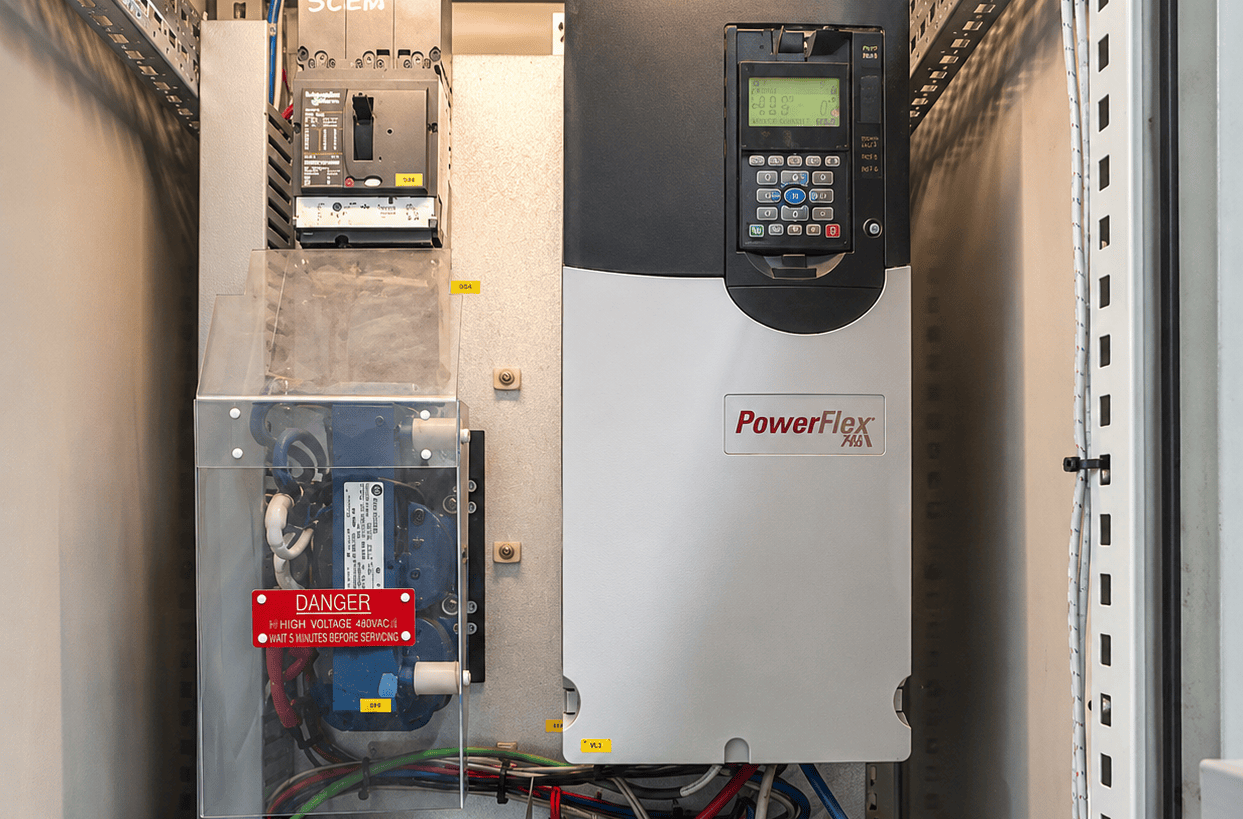
Variable Speed Drive Replacement Strategy

Project Details

Client:

Tier 1 Magnetite Miner

Date

February 25 - January 26

Location:

Karratha

Project Background

Our client initiated this project to address the growing business continuity risk created by the presence of obsolete Variable Speed Drives (VSDs) on critical assets. GTE Group developed a multi-year, phased replacement strategy to prioritise the most critical installations first—while also targeting improvements in safety, efficiency, cost control, and the rationalisation of VSD manufacturers and models across site.

The Challenge

Replacing legacy and non-standard VSD installations at an operating site required careful management of both physical integration requirements as well as control system and communications systems complexity.

Key challenges included:

  • Physical integration constraints: limited panel space, cable orientation/slack, cooling and heat dissipation requirements
  • Controls integration and migration: moving from DeviceNet to Ethernet/IP, translating legacy drive parameters, and integrating with the existing control system environment
  • Functional safety uplift: incorporating functional safety features into the new design
  • Operational constraints: shutdown coordination, machine weight/balance considerations, and training/support to enable safe transition and maintainability
  • Compatibility issues: fitment to existing panels, potential MCC modifications, and auxiliary equipment mismatches (brake resistors, filters, encoders), re-engineering non-standard installations

The Solution

GTE delivered an optimised strategy designed to minimise operational disruption while progressively reducing obsolescence risk and improving maintainability.

  • A phased, multi-year replacement program: A staged plan was developed to align replacements with shutdown windows, prioritising the most critical drives first to reduce exposure to unplanned failures.
  • FEED to de-risk repeatable installation patterns: Front-End Engineering & Design (FEED) was completed for representative installations to validate physical fit, cooling/heat load considerations, safety integration, and likely modification requirements before execution.
  • Standardisation and interoperability by design: To simplify spares holdings, training, diagnostics, and long-term supportability, the strategy targeted standardising low voltage VSDs to a single manufacturer and a consistent drive family.
  • Control system and network modernisation: A planned, staged migration from DeviceNet to Ethernet/IP enabled improved diagnostics and remote configuration—while maintaining seamless PLC integration.
  • Practical delivery levers to reduce outage time
    • Cabinet re-use prioritised to avoid wholesale panel replacement
    • Shipping breaks utilised for ease of handling
    • Automated configuration migration to streamline backup/restore of drive parameters during changeover

Outcomes & Impact

While implementation outcomes were recorded as ongoing, the strategy and study work established clear operational benefits:

  • Reduced business continuity risk by identifying and matching replacement options for each obsolete drive, with critical installations prioritised
  • Safety uplift through integration of modern functional safety features and standards-based review of stopping/isolation functions
  • Improved maintainability and efficiency via standardisation, better diagnostics, and simplified spares/training requirements
  • Cost and schedule control through phased execution, predictable budgeting, and vendor pricing agreement levers

Following successful delivery of the study work, GTE was subsequently engaged to support several staged upgrades.

From the Project Team

“One of the biggest challenges we faced was balancing technical integration with operational continuity… By standardising drives and leveraging automated configuration tools, we not only reduced downtime but also future-proofed the site for advanced diagnostics and functional safety.”

Outcome

GTE’s integrated electrical, control systems and communications expertise combined to deliver measurable benefits in in terms of reduction of production risks, improved safety and improved maintainability and efficiency.

We Want to Hear from You.

If you’re ready to hear more about how we can help your business operate safely and sustainably, get in touch with us today.

E-mail Head Office

admin@gtegroup.com.au

Physical Address

Level 2
109 St Georges Terrace
Perth, WA, 6000
Australia

Postal Address

PO Box 7099
Cloisters Arcade
Western Australia, 6850