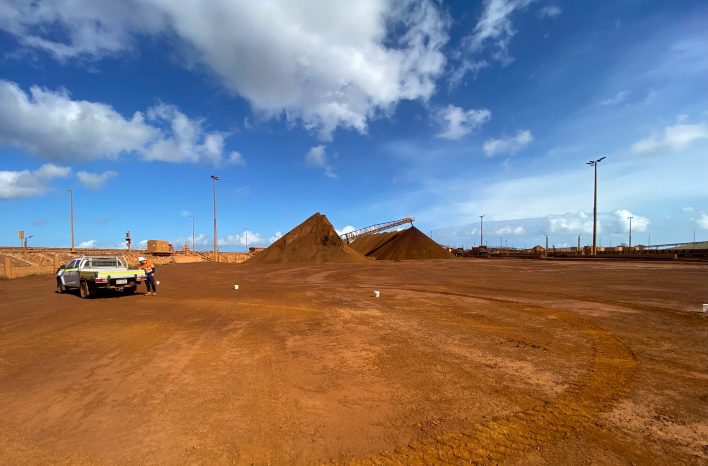
Stockyard Dust Suppression System Overhaul

Project Details

Client:

Pilbara Ports Authority

Date

July 2024 - March 2025

Location:

Finucane Island

Project Background

Pilbara Ports Authority (PPA) operates a large-scale stockyard and shiploading facility at Finucane Island. As a bulk material handling operator, PPA manages significant volumes of bulk material, which inherently generates dust due to environmental factors (particularly wind) and operational activities such as stacking, reclaiming, and ship loading.

As a licensed operator, PPA must comply with strict environmental regulations governing airborne dust emissions. Compliance is monitored by government environmental authorities, which have the authority to impose substantial penalties or suspend operating licences if dust limits are exceeded.

Maintaining effective dust suppression is therefore not only an environmental obligation, but also a critical operational and commercial requirement.

The Challenge

The existing Dust Suppression System (DSS) was partially manual and lacked integration with real-time operational and meteorological data. Key shortcomings included:
  • No dynamic response to actual weather conditions (wind speed, humidity, temperature)
  • No consideration of live stockyard operational status (stacking or reclaiming activities)
  • Limited automation of watering sequences
  • Manual record-keeping using spreadsheets completed by operational staff
  • Inaccurate and inconsistent reporting
  • Insufficient traceability to demonstrate regulatory compliance
As a result, dust suppression was reactive rather than predictive. Watering was not optimised, leading to periods of insufficient moisture (risking exceeding dust emission limits) or excessive application (risking water accumulation, operational inefficiencies and risking product deviating from its target moisture specification). It became clear that a fully integrated, automated, and model-based DSS was required.

The Solution

The legacy DSS was completely replaced with a newly engineered, model-driven control system integrated into the existing PLC/SCADA architecture. System Architecture
  • Core Dust Suppression logic implemented within the existing PLC platform
  • Visualisation, user interaction, data logging, and reporting implemented within the existing SCADA system
  • Seamless integration with weather monitoring systems and stockyard operational status signals
This approach avoided major hardware replacement while delivering a modern, intelligent control system.

Key Features of the New DSS

  1. Real-Time Surface Moisture Modelling

    A dynamic stockyard surface moisture model continuously calculates estimated moisture levels across defined stockyard zones. The model considers:

    • Water application history
    • Evaporation rates
    • Weather conditions
    • Operational disturbances

    This enables predictive rather than reactive dust control.

  2. Intelligent Water Cannon Control

    Watering is automatically controlled based on:

    • Modelled surface moisture levels
    • Live weather data
    • Defined environmental setpoints

    The system ensures:

    • Sufficient water application to suppress dust
    • Prevention of overwatering and pooling
    • Optimised water usage
  3. Operational Awareness

    The DSS integrates with stockyard operations and:

    • Automatically blocks water cannons during stacking or reclaiming
    • Prevents unsafe or counterproductive watering
    • Avoids interference with production equipment
  4. Multi-Level Manual Override Capability

    Operators can manually block watering at multiple hierarchical levels:

    • Individual cannon
    • Stockpile
    • Stockyard quadrant
    • Entire stockyard

    This provides operational flexibility while maintaining system integrity.

  5. Deluge Functionality

    The system allows controlled “stockyard deluge” operation to rapidly increase surface moisture in targeted areas when required due to:

    • Elevated wind conditions
    • Operational events
    • Pre-emptive environmental risk management
  6. Real-Time Visualisation

    The SCADA interface provides:

    • Live DSS status
    • Modelled surface moisture values
    • Cannon operational states
    • Water application trends
    • System alarms and overrides

    Operators have full situational awareness of dust suppression performance at all times.

  7. Automated Reporting & Compliance Traceability

    A fully automated reporting framework was implemented, including:

    • Detailed watering activity logs
    • Historical trend analysis
    • Surface moisture compliance verification
    • Automated report generation and distribution
    • Archiving for long-term regulatory traceability
Reports can be provided on demand to environmental authorities as objective evidence of compliance.

Project Outcome

The implemented solution transformed the dust suppression process from manual and reactive to automated and predictive. Key Achievements:
  • Maintenance of stockyard surface moisture at near-optimal levels
  • Significantly reduced risk of dust emission limits being exceeded
  • Eliminated manual spreadsheet-based reporting
  • Improved environmental compliance
  • Enhanced operational efficiency
  • Optimised water usage
  • Improved reporting and full historical traceability of DSS performance
The new DSS enables PPA to maintain regulatory compliance while optimising operational performance and resource usage. The system now operates with minimal manual intervention, providing robust environmental protection and demonstrable compliance documentation.

We Want to Hear from You.

If you’re ready to hear more about how we can help your business operate safely and sustainably, get in touch with us today.

E-mail Head Office

admin@gtegroup.com.au

Physical Address

Level 2
109 St Georges Terrace
Perth, WA, 6000
Australia

Postal Address

PO Box 7099
Cloisters Arcade
Western Australia, 6850